| Item or observation | What to investigate | Limit or caution |
|---|---|---|
| Speaker crossover | Coordinates speaker bass redirection in a managed system | Every channel's cutoff is one identical universal value |
| LPF for LFE | Limits the upper range of the LFE signal path | It replaces speaker crossover settings |
| Subwoofer low-pass control | Filters the signal handled by that control | It is always bypassed merely because an RCA cable is used |
1.Three controls can use similar-looking numbers
A crossover frequency is a filter setting used to divide frequency ranges between outputs. In a receiver, a speaker crossover can redirect low-frequency content toward the subwoofer. The LPF for LFE is a different control on the dedicated low-frequency-effects signal.
A receiver's speaker crossover, its low-pass setting for LFE and a subwoofer's rear-panel frequency control can all be expressed in hertz. That shared unit does not mean they control the same signal. One helps divide work between speakers and subwoofer, another concerns a dedicated programme channel, and another may filter the subwoofer's incoming signal.
The most useful first step is to draw the path. Identify the source, processor, subwoofer output and subwoofer input. Then ask which content reaches each filter. Without that map, matching all the printed numbers can produce a configuration that looks tidy while combining filters unintentionally.
2.A speaker crossover concerns a handover
In a typical bass-managed system, a speaker's crossover setting influences how its low-frequency content is redirected to the subwoofer and how the speaker's own output is filtered. The exact implementation depends on the processor. A crossover is not a perfectly sharp boundary where one box stops and another starts; the acoustic outputs overlap through a transition region.
That overlap is why level, timing and placement matter. The subwoofer and speaker can combine constructively or partially cancel at the listener. Changing a frequency setting without checking the combined result may move a problem rather than solve it. Start from the equipment guidance and the actual speaker capability, then verify integration instead of treating one widely repeated number as mandatory.
Once routing is understood, investigate alignment with Subwoofer Integration: Blend Bass With Your Main Speakers.
(1)A practical decision path
- 1
Define the task
Speaker crossover, LFE low-pass and subwoofer filtering act on different parts of a signal path. Identify those paths before matching numbers.
- 2
Check the distinction
Speaker crossover: Coordinates speaker bass redirection in a managed system: Every channel's cutoff is one identical universal value
- 3
Preserve the evidence
Save the original speaker configuration before adjusting it.
3.LFE is a channel, not a name for all bass
A multichannel soundtrack can contain low-frequency information in its main channels as well as a dedicated LFE channel. Bass management may redirect some main-channel content to the subwoofer. The subwoofer can therefore reproduce both redirected bass and the LFE signal, depending on configuration.
The low-pass control for LFE concerns that LFE path rather than defining every speaker's handover. Lowering it to match a main-speaker crossover is not a logical requirement and may remove intended content from that channel. Use the processor's documented guidance. If a menu's wording is unclear, look up that specific control rather than inferring its role from the presence of “bass” or “Hz.”
4.The subwoofer's filter belongs to another stage
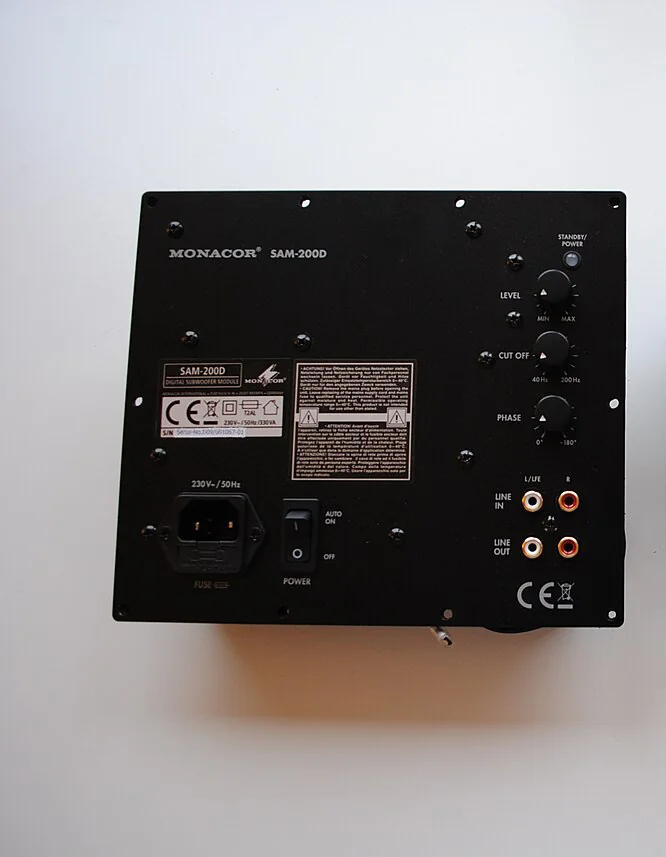
A powered subwoofer may provide a low-pass control for use with a source that does not already perform suitable filtering. With a receiver that handles bass management, the maker may specify a bypass or LFE mode. The procedure varies: a dedicated input, switch, menu option or control position may be involved.
Do not assume that an input labeled LFE behaves identically on every product. Check the manual's explanation of which controls remain active. If the receiver and subwoofer both apply low-pass filtering, their combined effect can alter slope, phase and level through the transition. That may be intentional in some designs, but it should not happen accidentally because two controls seemed to ask the same question.
5.Speaker size labels describe routing choices
Receiver labels such as small and large are easy to misread as judgments about cabinet dimensions. In many systems they describe whether bass is managed or sent more fully to the speaker. A physically large floorstander can still be assigned a bass-managed role when that suits the system.
Check options that send overlapping bass to both mains and subwoofer particularly carefully. More simultaneous output is not guaranteed to produce a smoother response at the seats. Interference and room interaction remain. Before enabling a double-bass-style option, understand the routing it creates and compare the result with a documented baseline. Do not use extra bass as evidence that integration improved.
6.A two-channel system may work differently
A stereo amplifier with a subwoofer output may provide a fixed filter, an adjustable filter or a full-range signal, depending on the model. It may leave the main speakers running full range. The presence of a socket labeled sub does not establish a complete high-pass/low-pass crossover arrangement.
Read the amplifier and subwoofer instructions together. If the mains remain full range, the integration question is different from a receiver applying a coordinated high-pass filter. That setup can still be useful, but advice written for one architecture should not be transferred blindly to the other. Identify the missing or fixed functions before searching for settings that the equipment does not actually offer.
7.Trace a hypothetical multichannel example
Imagine a receiver configured with bass-managed front, center and surround speakers plus one subwoofer. During a film, the subwoofer may receive redirected low-frequency content from several main channels and the programme's LFE content. Those contributions share an output destination, but they began as different signal roles. A control for one branch should not automatically be interpreted as a control for all branches.
Now imagine lowering the LFE low-pass setting while leaving speaker crossovers unchanged. That adjustment concerns the LFE branch under the receiver's implementation; it is not equivalent to lowering every speaker crossover. Conversely, changing the center speaker's crossover concerns that speaker's handover and redirection. Thinking in branches makes the menus easier to read than imagining a single pipe labeled bass.
This is a routing illustration, not a claim that every processor exposes identical controls or sums signals in the same internal arrangement. Use the actual manual to attach each menu item to the relevant branch. If a control's role remains undocumented, keep that uncertainty visible instead of treating an attractive diagram as proof of the device's architecture.
8.Check whether the mains are actually high-passed
A useful subwoofer integration plan asks what happens to the main speakers as well as what reaches the subwoofer. If the mains keep receiving the full-range signal, adding a low-pass filter to the sub does not by itself relieve their deep-bass workload. The system may have an overlap that must be evaluated on its own terms.
That arrangement can be appropriate in a supported design, but it differs from coordinated bass management that also applies a high-pass function to the mains. Read the documentation for the output and operating mode. The presence of a subwoofer socket, a crossover label or a rear-panel knob is not sufficient evidence about the main-speaker path.
The distinction is especially useful when the purpose of adding a subwoofer is greater clean output from compact mains. If that goal depends on reducing their low-frequency demand, confirm that the necessary function exists. Otherwise, a new box may add bass while leaving the original limiting workload largely unchanged. A complete signal-path description prevents that mismatch between intention and implementation.
9.Distinguish electrical settings from the acoustic result
A crossover frequency printed in a menu describes a processing setting. The sound at a seat also includes the loudspeaker's own response, the subwoofer's response, filtering and the room. The acoustic handover therefore should not be assumed to look like two ideal textbook lines meeting precisely at the displayed number.
This matters when a speaker already rolls off or interacts strongly with a nearby boundary. A chosen filter combines with that behavior rather than replacing it. Timing and relative level also influence the overlap. A smooth-looking electrical specification cannot independently establish a smooth acoustic sum at the couch.
If measurements are available, compare the relevant individual outputs and their combination under consistent conditions. If using listening, focus on a range of material through the transition and state the method's limits. Do not describe an unmeasured arrangement as perfectly aligned merely because the settings match a familiar recommendation. The settings are a controlled starting point; the combined response is the result to verify.
10.Avoid selecting a crossover from cabinet size alone
Cabinet size can influence a design's possibilities, but it does not establish the usable response and output of a specific speaker. A small center speaker, compact surround and floorstanding front pair may have different capabilities and placements. A processor that supports channel-specific settings can reflect those differences, subject to its documented workflow.
Start with the manufacturer and calibration guidance, then assess the actual requirement. A lower crossover is not inherently more advanced, and asking a speaker to handle deeper content is not automatically an improvement. It may increase demand or move the handover into an awkward region. A higher setting can also introduce its own placement or integration concerns.
Keep the decision tied to evidence: capability, output demand, location and combined behavior. If automatic setup produces an unexpected recommendation, investigate the conditions and manual rather than changing it simply to satisfy a visual preference. Save the original result so that a deliberate comparison remains possible. The goal is a workable division of labor, not the smallest number the menu permits.
11.Know what a bass test is exciting
A stereo music passage, a receiver's internal test noise and a multichannel LFE test can stimulate different routes. A successful subwoofer response to one does not verify the others. For example, a test sent only through an LFE path cannot independently prove that the front speakers' low-frequency content is being redirected correctly.
Name the test source and intended channel role in your notes. Use appropriate, documented material at a modest level and confirm the playback mode. Avoid inferring the source channel solely from the fact that the subwoofer moves. Its output can contain several contributions after processing.
This also helps interpret silence. If a programme has little low-frequency content in the route being tested, a quiet subwoofer is not necessarily faulty. Use the receiver's supported channel checks for routing and a suitable playback signal for integration. Keeping those tasks separate prevents unnecessary gain changes and avoids turning a creative programme choice into a hardware diagnosis.
12.Recheck settings after changing a playback mode
Some systems handle two-channel, direct and multichannel modes differently. A mode may bypass processing, alter speaker routing or use a separate subwoofer configuration. Product terminology varies, so a name such as pure or direct should not be treated as a complete technical description.
If bass disappears or changes markedly when the mode changes, inspect the documented routing before moving the subwoofer. Compare the same source and level, and note which controls remain active. An on/off comparison that changes bass management as well as equalization is not a clean test of either function alone.
Save a configuration for each ordinary use case if the equipment supports that arrangement. Include any limitation, such as a source requiring a particular output format. A reliable everyday setup is one whose behavior is understood when the input or mode changes. That is more useful than a carefully tuned result that works only under an undocumented combination of menus.
13.Verify the result in a useful order
Save the configuration, establish a practical subwoofer location, confirm routing and choose a documented starting crossover. Then evaluate the combined sound around the handover before making finer level or timing changes. Where measurements are used, compare individual and combined responses under the same conditions.
Check more than one seat and more than one programme. A large bass peak in one location does not establish a successful crossover, and a single weak note does not automatically call for more gain. Once the three filter roles are distinguished, changes can answer specific questions. The controls stop being competing versions of the same number and become understandable stages in the signal path.
14.Key terms and common questions
(1)A question worth checking
Should the subwoofer knob always be set to the same number as the receiver crossover?
Not necessarily. A managed system may require bypassing the subwoofer's filter according to its manual. Duplicating filters without understanding the path can change the handover.
15.Technical references and editorial scope
Research-based educational guidance. Sources support fact checking; they are not text to reproduce. No original measurements or hands-on product test are claimed. Follow the instructions for your equipment. Our editorial and corrections policy.
Have a question or spotted a correction? Write to the editors ↗