| Item or observation | What to investigate | Limit or caution |
|---|---|---|
| Channel processing | An AV receiver commonly manages multichannel playback | A stereo amplifier commonly serves two-channel playback |
| TV integration | Often includes HDMI routing and return-channel support | Capabilities vary; some include TV-oriented inputs |
| Bass management | May provide channel-specific routing and filtering | A sub output does not prove a high-pass filter for the mains |
1.What does a receiver do in a home audio system?
An AV receiver selects a source, processes supported audio into the configured channels, controls volume and powers connected passive speakers through its built-in amplifier channels. HDMI-equipped models can also route video to a display. It combines several system jobs in one box; it does not replace the speakers. A powered subwoofer normally uses its own amplifier and receives a signal from the receiver.
A stereo receiver serves a two-channel system, while an AV receiver is designed for audio and video routing with model-specific multichannel capabilities. A stereo integrated amplifier combines input selection, volume control and power amplification; a radio tuner is the traditional receiver distinction. Check the actual inputs and outputs because modern product names and features overlap.
For example, consider a streaming player connected by HDMI to an AV receiver, with another HDMI cable running to the TV. The receiver sends the picture onward and handles compatible sound for the connected speakers. If you use a TV app instead, audio can return over ARC or eARC when both ends support and enable it. This is an illustrative connection path, not a test of a particular product.
(1)A TV-and-music system
Two-channel playback and discrete surround need different functions. An overlap in inputs does not make the architectures interchangeable. This is an illustrative scenario, not a reported test.
| Your setup | A suitable starting option | Check before buying |
|---|---|---|
| Two passive speakers for music | Stereo integrated amplifier or stereo receiver | Speaker load, inputs and volume control |
| TV plus two passive speakers | Stereo product with a compatible TV input, or an AVR | ARC/eARC or optical format support and remote operation |
| Separate center and surround speakers | AV receiver with enough processing and amplifier channels | The exact layout and simultaneous channel support |
| Active speakers with their own amplification | Compatible source or preamplifier/control path | Use appropriate line-level connections; never feed speaker outputs into line inputs |
2.Channel roles determine part of the architecture
If the goal includes a separately driven center channel and surround speakers, the system needs appropriate decoding, outputs and amplification. A conventional two-channel amplifier does not acquire those roles because a television is connected to it. It may reproduce a compatible stereo signal perfectly well while serving a different objective.
Conversely, a listener committed to two channels does not need unused surround outputs merely to listen to music. There may still be useful receiver features, such as bass management or television routing, but each should have a purpose. Future expansion is worth considering when it is plausible; it should not become an excuse to optimize for an installation the room cannot physically support.
To identify the jobs already covered in your system, read Audio Signal Chain Explained: From Source to Speakers.
When adding a turntable, first match the route in the PHONO vs LINE: Choose the Right Input for Your Turntable.
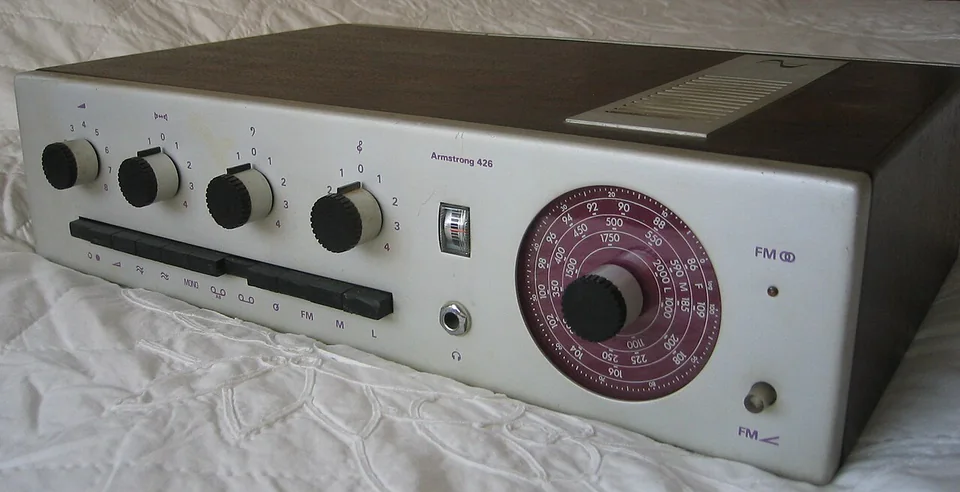
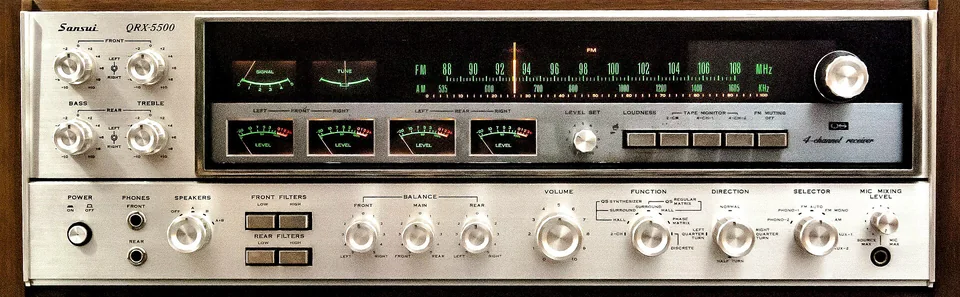
A multichannel receiver and a stereo amplifier illustrate different control layouts. The historical receiver is not evidence of modern HDMI or video features. Reference photography, not a SOUND & ROOM test or measurement.
3.Television convenience is a real requirement
Check how the television will deliver audio and how everyday volume control will work. HDMI ARC or eARC, optical input and analog output involve different capabilities and constraints. A stereo product with an HDMI return-channel input may meet a simple TV-and-music brief, while another stereo amplifier may need an external conversion or control stage.
Read format support rather than assuming every digital input accepts every television output. If the amplifier requires two-channel PCM, configure a compatible path according to the manuals. Also check standby behavior, input switching and remote operation. A technically capable system that is awkward for everyone else in the household is not fully suited to its intended use.
For sound returning from TV apps, use HDMI ARC vs eARC: Formats, Connections and Common Problems.
4.Investigate the subwoofer path in detail
A subwoofer socket establishes an output connection, not necessarily a complete crossover. Some products provide adjustable bass management; others send a filtered or full-range subwoofer signal while leaving the main speakers unchanged. The main-speaker high-pass behavior matters when the goal is to reduce their low-frequency workload.
Look for documented crossover frequencies, filter controls, level adjustment and timing options. If automatic calibration is available, find out what it measures and changes. A receiver may offer more flexibility here, but the exact product must establish that capability. A stereo system can also integrate a subwoofer successfully; it simply needs a clear account of where the filtering and control happen.
5.Compare power figures under compatible conditions
A large watt number is difficult to interpret without load, distortion and channel conditions. A multichannel rating and a two-channel rating may not describe comparable tests. Do not divide a headline total by the number of sockets or assume that every channel can deliver the same continuous output simultaneously under every condition.
Match the amplifier's documented load guidance to the speakers and the intended operation. Required output depends on listening distance, programme and level as well as speaker behavior. Cabinet weight and transformer photographs are not substitutes for appropriate evidence. If the data do not support a confident comparison, state that limitation instead of declaring a winner from one incomplete figure.
6.Processing can be useful without being compulsory
Room correction, tone controls, dynamic-range options and channel trims can solve specific practical problems. Their presence is not inherently an obstacle to careful listening, and their absence is not proof of a purer result. The important questions are what the processing does, whether it is needed and whether its effect can be compared fairly.
Check which functions remain active in direct or bypass modes. Product terminology varies, and bypassing processing may also disable a useful bass-management function. Compare complete operating modes at a steady level rather than assuming that the shortest menu name must sound best. Keep a record of the configuration you actually use.
7.Make the final choice about the finished system
For a two-speaker television system, a suitable stereo amplifier may provide every needed function with convenient operation. For discrete surround playback, an appropriate multichannel architecture is necessary. For demanding bass integration, either category needs the right controls or a deliberately added external stage.
Choose the arrangement with a clear signal path, adequate documented capability and controls that suit daily use. Do not treat a category preference as evidence about every model within it. A defensible choice explains which jobs are fulfilled, which remain external and which features are intentionally unused. That is more useful than an unsupported claim that one kind of box is universally more musical.
8.Key terms and common questions
(1)Checks to keep the comparison useful
- List current and likely future channel roles.
- Check the exact television connection and audio formats.
- Confirm subwoofer filtering rather than just socket presence.
- Read power specifications with their test conditions.
(2)A question worth checking
Is a stereo amplifier always better for music?
The category alone cannot establish audible performance. Compare the required functions and relevant evidence for the particular products under suitable conditions.
9.Technical references and editorial scope
- Dolby: home theater setup ↗
- HDMI Licensing Administrator: enhanced audio return channel ↗
- Denon: AV receiver functions and amplifier differences ↗
Research-based educational guidance. Sources support fact checking; they are not text to reproduce. No original measurements or hands-on product test are claimed. Follow the instructions for your equipment. Our editorial and corrections policy.
Have a question or spotted a correction? Write to the editors ↗