| Turntable route | Next connection | Phono stage in use |
|---|---|---|
| PHONO output, no external stage | Compatible amplifier PHONO input | Amplifier stage |
| LINE output from enabled internal stage | Compatible analog AUX/LINE input | Turntable stage |
| PHONO output to external phono stage | External stage output to compatible line input | External stage |
1.Read the output and input as a pair
PHONO and LINE describe different points in the turntable signal path. The cartridge supplies a small signal that needs a compatible phono stage; a turntable with an enabled internal stage provides an output intended for a line input. Lenco explains that the phono stage supplies both gain and playback equalization. It is more than a volume boost.
Start by reading the label at each end of the cable. A pair of red and white RCA connectors does not tell you whether the signal is phono level or line level. Write the turntable output setting and destination input together, not on separate shopping lists.
The connection table is a starting map, not a compatibility certificate. Cartridge requirements and the actual function of a socket still come from the manuals. If one label is unclear, resolve that uncertainty before increasing volume.
(1)The same plugs can carry different signals
Hypothetical route cards, not listening tests. Identify the active phono stage before comparing volume.
2.Find the phono stage before adding another box
There are three common locations to investigate: inside the turntable, inside an amplifier or receiver, and in a separate enclosure between them. An external phono preamplifier is useful when it supplies a function your chosen route otherwise lacks. It is not automatically required because the system uses vinyl.
Trace the route from the turntable toward the speakers and mark the phono stage you intend to use. Then check whether an upstream stage is enabled and whether a downstream socket is another phono input. This is a documentation exercise; the number of boxes on the shelf is not a reliable count of processing stages.
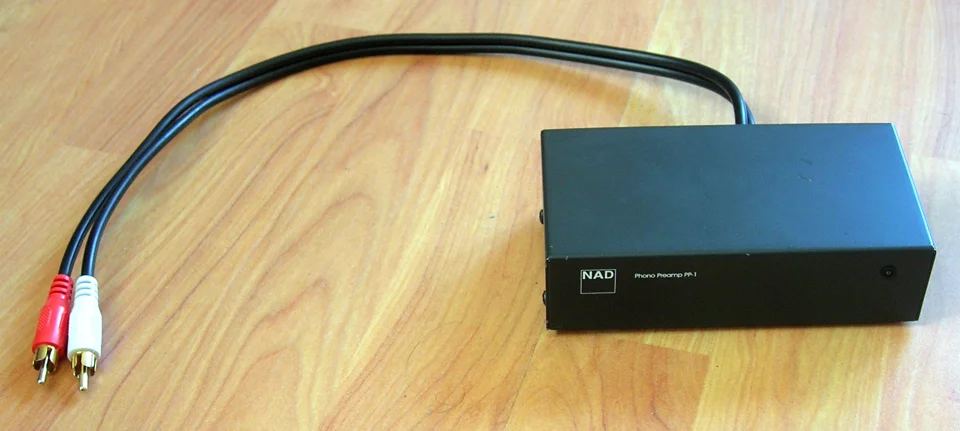
The reference photograph shows an external NAD phono preamplifier and RCA plugs. It illustrates the separate-box option only. The picture cannot establish which cartridge another stage accepts, what a hidden rear socket does, or how a turntable selector is set. It is not a product recommendation or a SOUND & ROOM test.
To place the remaining system functions, read Audio Signal Chain Explained: From Source to Speakers.
3.Match the selector to the destination
Pro-Ject documents both output choices on its Debut S Phono: its LINE route is intended for a line input, while PHONO OUT is used with a phono preamplifier. That is a concrete example of following the output setting through to its destination rather than choosing a label in isolation.
A turntable set to PHONO feeding an external phono stage should continue from that stage to the amplifier input specified for its line output. Do not send that processed output into another phono input simply because both products concern records.
Some turntables have no selector, and some amplifiers label or configure their inputs differently. Do not assume that a switch location or menu option seen on a review video exists on your model. A source name shown on an amplifier display can also differ from its physical socket label. Record both if an input can be assigned or renamed.
4.Check a quiet or distorted result without chasing the volume
Audio-Technica's AT-LP5 documentation illustrates why the selector matters: a PHONO output connected to an AUX/LINE input can produce very weak sound, while the wrong opposite pairing can produce excessive level or distortion. Use that as a connection clue, not a diagnosis that applies to every quiet record player.
Stop playback and lower the listening level before changing the route according to the equipment instructions. Keep the record, selected passage and speaker arrangement fixed. After confirming the documented combination, start quietly and increase only enough to make a useful comparison.
Write down whether the change restored ordinary level and tonal balance, affected one channel or made no difference. Do not compensate for an uncertain route by winding the main volume far above its normal setting. A corrected connection can produce a much larger signal when playback resumes.
5.Keep cartridge compatibility separate from socket shape
A PHONO label does not establish that the input suits every cartridge. Check the cartridge type and the stage's supported gain and loading options. For example, the Pro-Ject guide specifies an MM input for its factory-fitted cartridge; that instruction describes that combination, not every turntable sold under the same brand.
If a cartridge has been replaced, record the replacement model rather than relying solely on the turntable's original specification. If a used system comes without that information, identifying the fitted cartridge is more useful than buying a preamp on the strength of its connector photographs.
This guide does not provide a universal gain, capacitance or impedance setting. Keep those values attached to the exact cartridge and stage instructions. Nor does a line output directly drive ordinary passive speakers: the rest of the system still needs the appropriate amplification and volume control.
For the amplification needed after a line output, see Active vs Passive Speakers: What Does Your System Need?.
6.Use a three-line route card
In this hypothetical example, a listener connects a switchable turntable to an amplifier AUX input and hears very weak audio. The route card reads: turntable output PHONO; intervening stage none; destination AUX. That record identifies a missing function in the proposed route before any cable or speaker is replaced.
The listener checks the turntable manual, enables its supported LINE output and repeats the same passage from a low level. If ordinary playback returns, the result supports that routing explanation under the tested conditions. It does not compare the internal stage with a premium external one or measure fidelity.
For your own card, record the output setting, the phono stage in use and the destination input. Add one sentence describing the observed result. A reversible note makes later upgrades easier: you can change one stage deliberately instead of adding an undocumented combination of processing.
7.Know what this comparison cannot resolve
If a documented route still produces silence, channel loss or distortion, stop cycling between PHONO and LINE. Record the cartridge, stage, amplifier input and symptom, then consult the relevant troubleshooting instructions. A selector comparison does not establish stylus condition, mechanical setup or an electrical fault.
Hum is also a separate observation from insufficient playback level. Follow the signal-ground connection instructions for the equipment; do not remove protective earth or improvise mains wiring. Keep physical repairs and internal work outside a signal-routing experiment.
Once the route is correct, compare listening results at a sensible, consistent level. A louder setting is not in itself evidence of a better phono stage. The useful outcome here is a compatible connection you can explain and reproduce, with its limits written down.
8.Key terms and common questions
(1)Before changing a selector
- Record cartridge and equipment model names.
- Identify the phono stage intended for this route.
- Read the output setting and destination input together.
- Lower the listening level and preserve the original settings.
(2)Common phono and line questions
Is a phono preamp the same as a power amplifier?
No. A phono stage prepares a cartridge signal for the next stage; it does not replace the amplification needed to drive ordinary passive loudspeakers.
Does an RCA cable convert PHONO to LINE?
The plugs do not perform the required processing. Match the stage and input, not just the connector shape.
Should LINE output go to a receiver PHONO input?
For the conventional turntable routes described here, use a compatible line input for LINE output. Check both manuals rather than adding a second phono stage.
9.Technical references and editorial scope
- Lenco: phono and line functions ↗
- Pro-Ject Debut S Phono original guide ↗
- Audio-Technica AT-LP5 manual ↗
Research-based educational guidance. Sources support fact checking; they are not text to reproduce. No original measurements or hands-on product test are claimed. Follow the instructions for your equipment. Our editorial and corrections policy.
Have a question or spotted a correction? Write to the editors ↗