| Item or observation | What to investigate | Limit or caution |
|---|---|---|
| Response shaping | Can change the applied frequency balance | Cannot make every seat physically identical |
| Level and timing setup | Can coordinate supported channels | Cannot move an obstructed loudspeaker |
| A deep cancellation | May resist useful correction by boost | Source or seat position may need investigation |
1.Calibration acts through the available system
Room-correction software can measure aspects of a playback system and apply supported adjustments. Depending on the implementation, those may include channel level, delay, equalization and other processing. It works through the existing loudspeakers and room. It does not relocate a cabinet, clear an obstruction or change the building's transmission paths.
That distinction gives automatic calibration a useful place in the workflow: after a sensible physical arrangement and correct routing, before final verification. Treating it as a replacement for placement can leave the processor trying to compensate for problems better addressed mechanically. Treating it as worthless because it cannot solve everything overlooks the specific tasks it may perform well.
2.Give the microphone a defined job
Follow the correction system's own microphone and position instructions. Different systems use different sampling strategies, so a generic internet pattern may not match the algorithm's assumptions. Use an appropriate stable support, keep the room quiet and avoid placing the microphone against furniture unless the procedure calls for it.
The chosen positions communicate a listening priority. A compact cluster around one seat and a wide spread across a large couch do not describe the same objective. Do not measure irrelevant positions merely to fill a required count. Document the main seat and the additional positions so that a later calibration can be compared meaningfully.
For crossover-region timing questions, follow Uneven Bass in a Room? A Step-by-Step Diagnosis Workbook.
For a repeatable post-calibration listening and configuration check, see Home Theater Calibration: What to Check After Auto Setup.
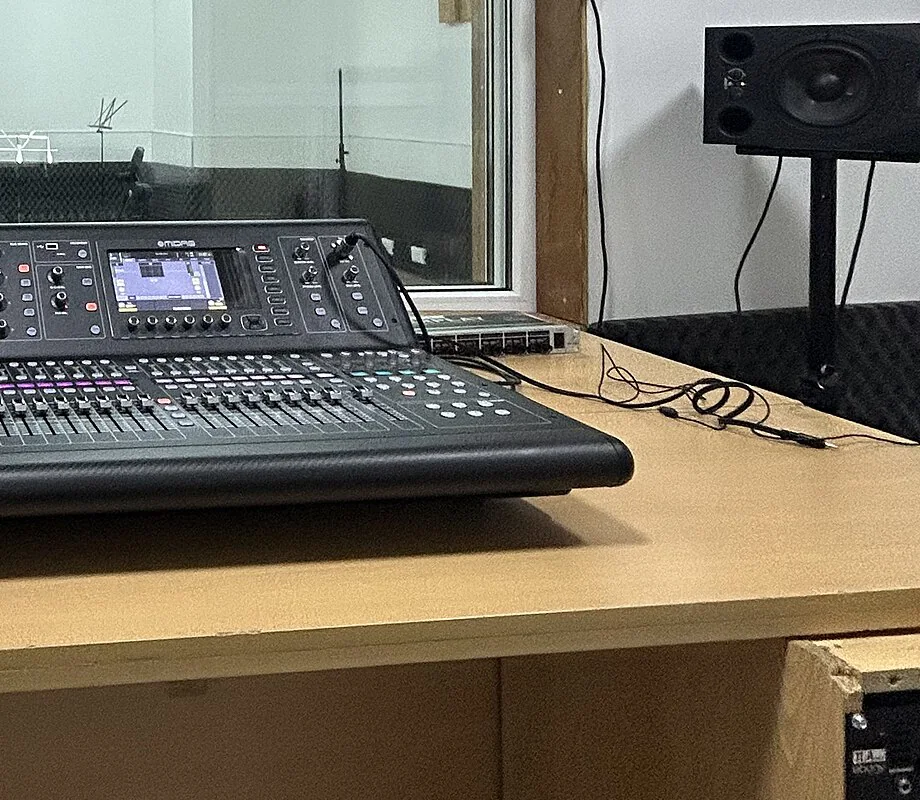
Shows monitor/listener/room relationships; neither image is a measured before/after correction result. Reference photography, not a SOUND & ROOM test or measurement.
3.Peaks and cancellations are not interchangeable
A response peak can sometimes be reduced effectively with equalization when it is suitably characterized and remains relevant over the target area. A deep cancellation at one point is more difficult to repair by simply adding output: the cancellation mechanism can remain while extra electrical and mechanical demand increases elsewhere.
The exact behavior depends on the source, room and filter strategy, so avoid universal claims about every dip. The practical rule is to investigate the cause and spatial variation before asking for large boosts. If a nearby seat or modest source move changes the weak region strongly, that is evidence that physical arrangement deserves attention. A target matcher cannot turn an impossible correction demand into free headroom.
(1)Checks to keep the comparison useful
- Set up speakers and routing before measuring.
- Use the supplied microphone procedure and a quiet room.
- Inspect assignments, levels and crossover choices afterward.
- Verify results at the intended seats, not just on a predicted graph.
4.One position does not represent the whole couch
Equalization applies through the system, while the room's response changes with position. A filter that improves a narrow feature at one seat may do less elsewhere or create a tradeoff. Multi-position methods can aim for a useful compromise, but they do not abolish spatial variation.
Inspect individual positions as well as any average. An average can conceal one seat's strong peak and another's deep dip. Define success in terms of the intended listening area: a better primary seat, reduced variation across several seats, or a balanced compromise. Without that definition, a single smooth line can look like success while ordinary listeners still encounter a very different result.
5.Timing results need interpretation
A reported distance can represent an acoustic or processing relationship rather than a tape-measure length. Subwoofer electronics and filters can contribute delay. Do not replace every unexpected value with a physical measurement simply because the latter appears more intuitive.
At the same time, inspect grossly implausible assignments and check the equipment guidance. An obstructed microphone, wrong channel or setup error should not be accepted blindly. The right response is to understand and verify the result. Save the original output before manual changes so that a later improvement or failure can be traced to a particular adjustment.
6.Targets and correction range are choices
A target curve describes an aim, not a universal law of enjoyable domestic listening. The appropriate shape and correction range depend on the system, measurement context and intended use. Extending correction across every visible detail can encourage attention to features that are not useful to pursue with that method.
Read the tool's explanation of smoothing, frequency limits and filter constraints. If you compare targets, keep level and programme consistent and note whether a change affects overall bass quantity as well as smoothness. A louder or bass-heavier presentation can influence preference without demonstrating more accurate room compensation. Describe the actual change rather than assigning it an automatic quality label.
7.Verification is a separate stage
A predicted response is calculated from measurements and proposed processing. A new measurement checks what the system actually does after those settings are applied. The distinction matters when routing, filter implementation or controls differ from the model's assumptions.
Use the same documented conditions for before-and-after checks, then inspect nearby seats. For listening comparisons, understand which functions an on/off switch changes; it may affect more than equalization. Keep essential routing and safe levels intact. A fair comparison asks a specific question, such as whether a persistent bass peak is reduced without an unacceptable loss of output, rather than whether the “calibrated” label sounds more impressive.
8.Inspect the setup report before judging the sound
An automatic process often produces a report of detected speakers, levels, distances or crossovers. Review those results before making a listening judgment. A missing speaker assignment or an incorrectly selected layout can influence the entire result. Calibration cannot be evaluated fairly while the configured system differs from the physical installation.
Check the report against the manuals and the known arrangement, keeping unexpected acoustic timing values separate from obvious routing mistakes. If something appears wrong, repeat the relevant setup step under proper conditions rather than manually changing every reported value. Save both attempts if the result changes, because that difference may reveal an unstable measurement condition.
Do not turn the report into an obedience test. The right response is neither unquestioning acceptance nor automatic replacement with preferred numbers. Ask what each value represents and how it was obtained. A report is useful evidence about the process, with enough detail to guide a verification or a support question. Its authority comes from a valid method and a checked result, not from the fact that software displayed it.
9.Keep individual seat results visible
A correction system may summarize several measurement positions. That summary serves a purpose, but it can obscure differences that matter to listeners. Where the tool allows it, inspect individual responses or make separate verification measurements at the intended seats. Label them clearly and preserve the same measurement conditions.
Suppose the primary seat improves while one outer position gains an unwanted peak. The correct conclusion depends on the stated priority and magnitude of the tradeoff. It should not be hidden behind a smooth average. A system serving a whole couch may need a different physical arrangement or correction compromise from one serving a single chair.
This is also a reason to avoid measuring positions unrelated to ordinary use. Adding more points does not automatically improve the relevance of a calibration. Follow the algorithm's instructions, but make the listening-area definition deliberate. The useful question is whether the sampled area represents the people and positions the finished system must serve, not whether the largest possible region has been included.
10.Avoid stacking corrections without a map
A source application may apply equalization, a receiver may apply room correction and a subwoofer may retain its own filters. Each can be valid, but their combined effect needs to be understood. A new calibration should not silently inherit an old experimental filter whose purpose has been forgotten.
Record all processing stages and establish the starting state required by the chosen workflow. If one stage is intentionally retained, include it in the measurement conditions. Do not assume that a bypass switch on one device removes processing elsewhere. The signal chain extends beyond the calibration application's screen.
After applying the final configuration, verify the actual playback route used every day. A measurement made through a different input or mode may not check the same combination of filters. If a result is unexpectedly strong or weak, inspect the whole map before asking the correction software for another pass. Repeating an automated process on an unknown accumulated filter chain can make the result harder to explain with each iteration.
11.Compare correction without changing several jobs at once
An apparent correction on/off comparison may also change overall level, bass management, channel timing or dynamic processing. Learn what the control actually bypasses. If several functions change together, describe the comparison as a comparison of complete modes rather than evidence about equalization alone.
Use the same programme and a carefully controlled level. A modest loudness difference can influence preference, while a changed crossover can alter output capability and integration. Record those differences if they cannot be held constant. A useful comparison does not need to be perfect, but it must not claim to isolate a function that was never isolated.
Listen for the original problem first: the dominant note, the broad imbalance or the inconsistent transition. Then check for unwanted consequences across several sources and seats. If the effect is unclear, retain uncertainty rather than choosing the setting with the more reassuring name. The purpose of comparison is to learn what changed in the actual system, not to confirm that a completed calibration must have improved it.
12.Revisit calibration when its conditions change
Moving a subwoofer, changing the main-speaker arrangement or relocating the listening area can invalidate parts of an earlier calibration. Save the previous project and settings, then follow the appropriate setup sequence for the new geometry. A filter set belongs to measured conditions rather than permanently to the equipment model names.
Small household changes do not necessarily require a complete restart. Begin by checking the relevant listening behavior and a few important positions. If the original problem has not returned and the signal path remains the same, extensive repeated calibration may offer little value. If a significant difference appears, the saved baseline helps identify what changed.
Treat a new calibration as a documented revision. Record the reason, measurement positions, target and manual adjustments. That history makes the system maintainable and prevents a later reset from erasing the only explanation of a useful result. The goal is a repeatable method that survives ordinary changes, rather than one impressive setup session that nobody can reproduce.
13.Decide what remains a physical problem
If the result still has severe seat variation, investigate source and listener positions. If dialogue is obstructed, move or aim the speaker appropriately. If the room has an objectionable reflective character, suitable treatment may deserve study. If neighbors are disturbed, consider transmission and operating level separately.
Correction is most useful when its job has a boundary and its result is checked. Save the measurement positions, target, resulting controls and any manual changes. That record makes the next calibration an informed revision rather than a ritual reset. The goal is a more useful listening system, not merely an attractive completion screen.
14.Key terms and common questions
(1)Terms used in this guide
- Target curve
- The response shape a correction process aims toward under its model.
- Predicted response
- A calculation of expected behavior, distinct from a new verification measurement.
- Spatial variation
- Differences in response between positions.
(2)A question worth checking
Should I accept a perfectly flat predicted line?
Treat it as a model output. Check the target, constraints and actual measured result; a smooth preview does not prove a uniformly smooth listening area.
15.Technical references and editorial scope
Research-based educational guidance. Sources support fact checking; they are not text to reproduce. No original measurements or hands-on product test are claimed. Follow the instructions for your equipment. Our editorial and corrections policy.
Have a question or spotted a correction? Write to the editors ↗