Checks to keep the comparison useful
- Mark cabinet positions and the listening seat.
- Keep spacing and wall distance fixed.
- Use a centrally mixed voice plus a separate music passage.
- Compare the center and outer seats at a steady level.
1.Choose a question that an angle change can answer
Toe-in changes the direction in which a speaker faces. It can alter the balance of direct and reflected sound at a seat, the perceived center image and the way the presentation changes across a couch. It cannot repair a disconnected driver, a reversed cable or a badly mismatched channel level. Establish that the system is working normally before interpreting small angle differences.
Pick one primary question: is the central voice stable, is the treble balance comfortable, or can more than one person hear a coherent presentation? These questions can lead to different compromises. A single sharply focused seat is not necessarily the best result for a shared listening area. Writing the goal down prevents a long session of rotations with no clear stopping condition.
2.Record a physical baseline
Mark the front corners of both cabinets with removable tape that is safe for the floor finish. Note the listening position and speaker-to-seat distances. A photograph helps recover the arrangement, but a photograph alone is poor at recording small angles. Use a simple sketch and a consistent reference edge on the cabinet.
Keep the cabinet location as steady as possible when rotating it. Rotation around an inconsistent point can also alter distance from the wall and the listener. Check cable slack, support stability and any spikes or feet before moving the enclosure. If the speaker is too heavy to move safely, obtain assistance rather than twisting it on an unstable support.
If angle changes expose a coverage question, compare it with Speaker Placement: Get Clearer Stereo Sound in Your Room.
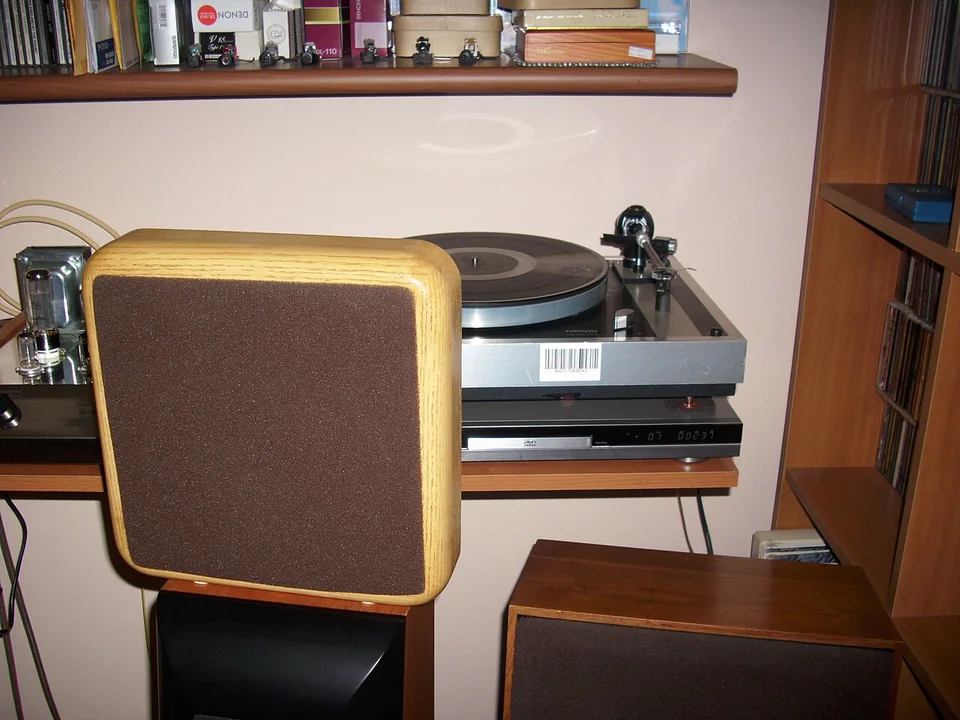
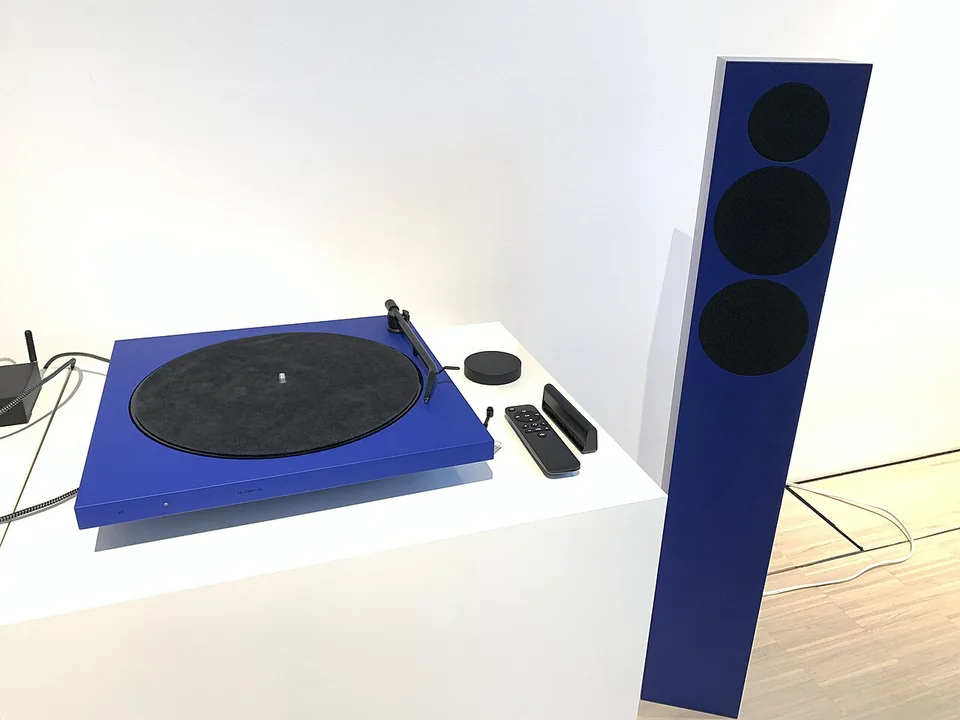
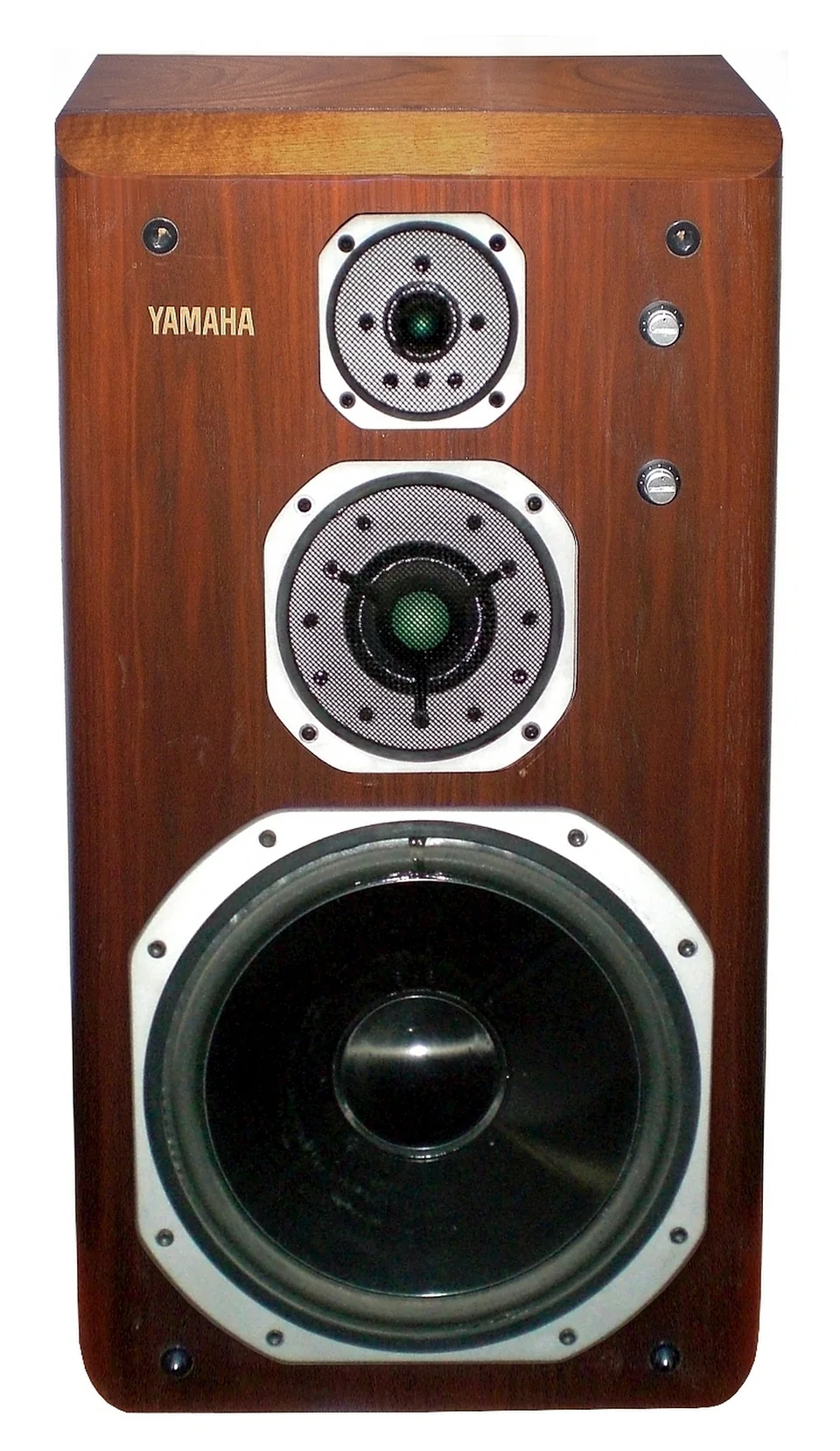
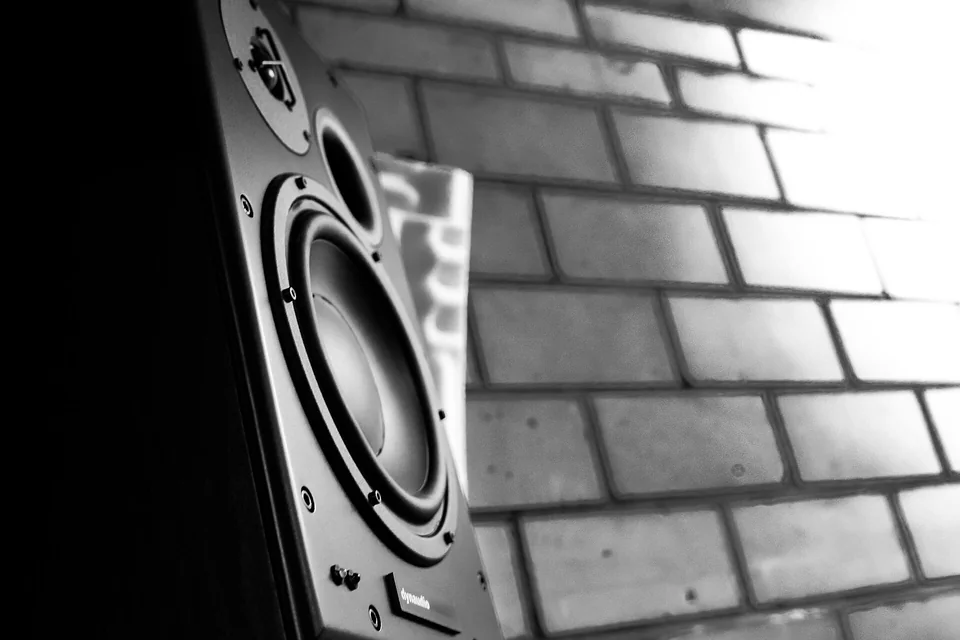
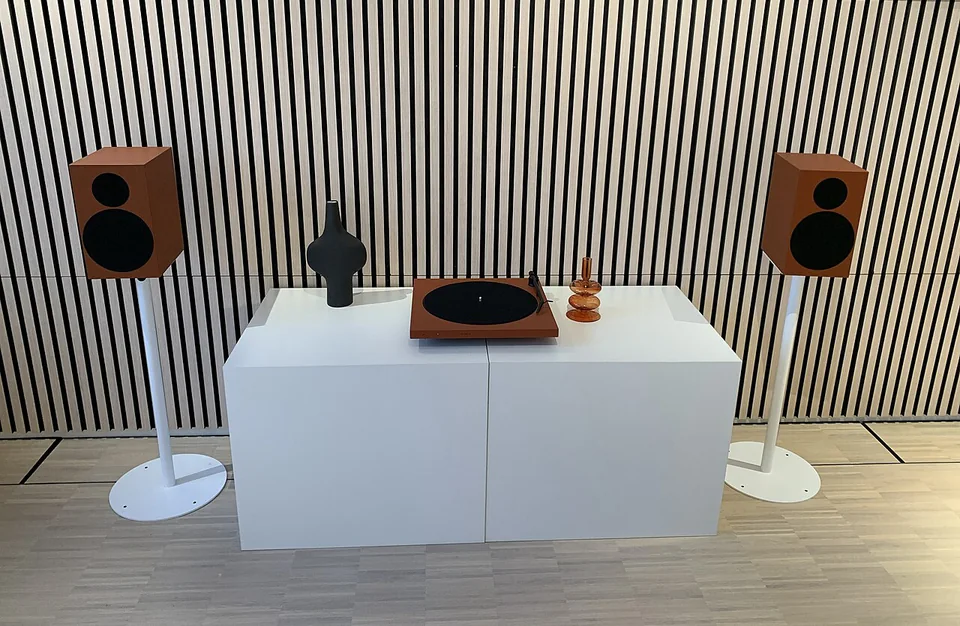
Shows loudspeaker orientation and a domestic placement context for the angle-comparison process. Reference photography, not a SOUND & ROOM test or measurement.
3.Follow the design's intended starting point
Some loudspeakers are intended to face the listener; others have different recommended orientations. The manufacturer's guidance establishes a sensible first arrangement because the reference axis and radiation pattern belong to that design. Do not assume that an attractive symmetrical photograph identifies the acoustically intended direction.
In the absence of specific guidance, use a modest, clearly documented starting angle. Avoid treating a precise number found for a different speaker as a universal rule. Cabinet shape can make visual estimates misleading, particularly with curved enclosures. The purpose is to create repeatable alternatives, not to manufacture an appearance of precision that the setup cannot support.
4.Make one modest change and replay the same passage
Use a familiar centrally mixed voice for image position and a separate passage with useful high-frequency content for tonal balance. Keep the source, processing and master volume unchanged during the first comparison. If a passage is excessively bright or unusual, do not make the entire installation serve that one recording.
Rotate both speakers by a small, similar amount and listen again. Describe the result before deciding whether it is better: the voice appears wider, the center is steadier, or the outer seat loses treble. Those observations are more informative than “more musical.” Return to the original marks and replay the same short section. A benefit that disappears on return deserves less confidence than one that survives repeated comparison.
| Item or observation | What to investigate | Limit or caution |
|---|---|---|
| Voice shifts at the center seat | Check distances and channel balance first | Do not use extreme angle to hide a wiring mistake |
| Treble balance changes off-center | Compare a few modest angles | Record the useful listening area |
| One angle seems immediately louder | Return to the baseline at a steady level | Loudness can bias preference |
5.Check the other seats before keeping the change
Move to the left and right seating positions while leaving the system untouched. Note changes in level, image location and tonal balance. The nearest speaker naturally has a different geometric relationship to an off-center listener; angle can influence the tradeoff, but it cannot make every seat physically identical.
If the main seat improves while the rest of the couch becomes noticeably less useful, decide which priority matters. You might keep the wider-coverage arrangement for family listening and record a different angle for occasional focused use, provided moving the speakers is practical. There is no requirement that one compromise win every use case. The important part is understanding what was gained and what was sacrificed.
6.Investigate asymmetry rather than forcing symmetry
An open doorway on one side and a nearby wall on the other can make equal cabinet angles produce unequal listening conditions. First verify distance and channel balance. Then document the room difference. A small asymmetric orientation may be practical, but use it as a deliberate response to observations rather than a random correction.
If changes seem contradictory, stop and restore the baseline. Recheck whether spacing, seat location or a processing mode changed inadvertently. Strong bass variation is usually a reason to examine position and room interaction separately; toe-in alone is not an efficient tool for diagnosing every low-frequency problem. Keeping the investigation narrow makes the result easier to trust.
7.Finish with a setting and a reason
Keep the selected positions marked long enough to live with them across several recordings. Save a short note describing the goal, approximate angle and tradeoff across seats. If the difference was inconsistent, the practical original arrangement remains a valid choice. The method has still established that angle was not an obvious solution to the chosen problem.
Do not continue indefinitely in pursuit of a supposedly perfect rotation. Once the system provides a stable, comfortable presentation over the intended area, another problem may deserve attention. Speaker angle is a useful adjustment because it is reversible and easy to compare, not because it promises to transform every room.
8.Key terms and common questions
(1)A practical decision path
- 1
Mark the baseline
Keep cabinet locations and seat fixed.
- 2
Rotate deliberately
Compare a modest angle change with the same passage.
- 3
Check the listening area
Keep or revert after checking center and outer seats.
(2)A question worth checking
Should the axes cross in front of the listener?
That can be worth comparing with some radiation patterns, but it is not a universal prescription. Begin with the maker's guidance, then evaluate the actual seats.
9.Technical references and editorial scope
Research-based educational guidance. Sources support fact checking; they are not text to reproduce. No original measurements or hands-on product test are claimed. Follow the instructions for your equipment. Our editorial and corrections policy.
Have a question or spotted a correction? Write to the editors ↗