Checks to keep the comparison useful
- Confirm that a center channel is actually connected and configured.
- Keep the speaker securely supported and its output unobstructed.
- Check the acoustic axis guidance for the particular model.
- Listen from the outer seats as well as the main seat.
1.Verify the channel before moving the cabinet
A center loudspeaker is useful only when the processor knows it exists and routes the intended signal to it. Check the speaker configuration and use the receiver's documented channel-identification procedure at a modest level. A familiar film is a useful final check, but it is a poor first tool for identifying routing because dialogue can move or be mixed with other channels.
If there is no physical center speaker, the system must be configured accordingly so that it can handle the missing channel as intended. Do not declare a center present merely because the source contains one. Conversely, a soundbar's internal channel arrangement should not be treated as if it were a conventional receiver with separate terminals. Establish which system you have before applying placement advice.
2.Find the least obstructed position near the screen
The practical objective is to associate centrally placed screen sound with the picture while giving the loudspeaker a clear path to listeners. Common positions are above or below a display, subject to the speaker and mounting instructions. Neither is automatically correct if a shelf edge, console door or decoration blocks the radiating area.
Inspect the path from the cabinet to seated ear positions. A speaker pushed to the back of a deep shelf may be surrounded by nearby surfaces that change its response. Moving it forward can be worth comparing if the support remains secure and all required clearances are maintained. Never let the front edge overhang an unsuitable support simply to create a cleaner photograph.
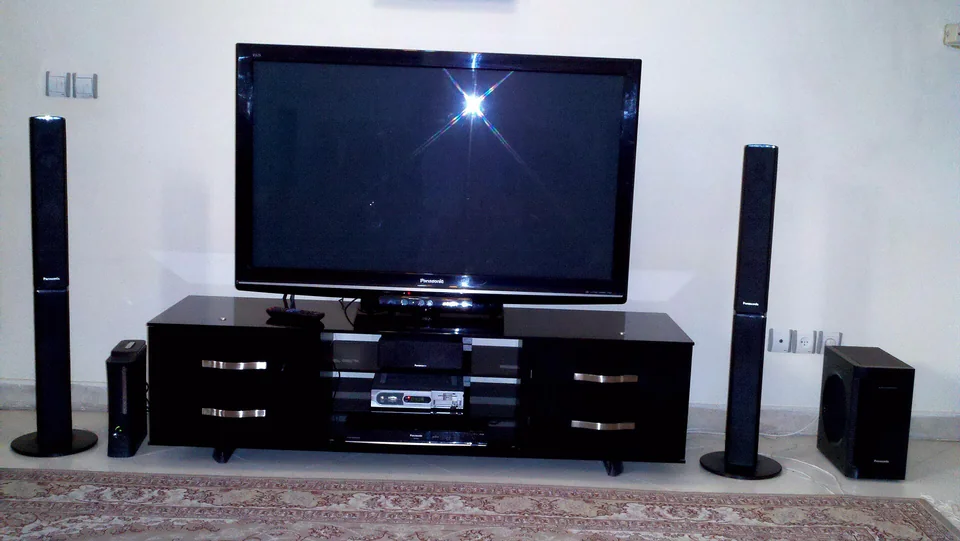
Below the TV: use a secure support, keep the radiating area clear of the console edge, and aim toward seated ears if the speaker guidance permits. Above the TV: use a rated mount and an approved downward aiming arrangement. Inside furniture: first check ventilation, port clearance and whether the front opening blocks the speaker. Never pull a cabinet forward beyond stable support just to align its front edge.
There is no single correct height in inches for every couch and screen. Measure your seated ear height and compare it with the speaker's recommended listening axis. Then listen from the center and both outer seats using the same speech passage and volume. If only the side seats lose clarity, investigate coverage and obstructions before increasing the center level for everyone.
| What you hear | First check | What the result suggests |
|---|---|---|
| Every seat sounds muffled | Inspect the grille area, shelf lip and objects in front | An obstruction is worth correcting before any trim boost |
| Center seat is clear; side seats are not | Repeat the same passage from each outer seat | Coverage or a local obstruction needs investigation |
| Sound changes when you sit taller | Compare speaker aiming with the recommended listening axis | A secure, approved aiming adjustment may help |
| Only one app or film is difficult | Try another source with the same physical setup | Use the source and dialogue troubleshooting path first |
3.Aim deliberately and support safely
When the speaker sits well below or above listeners, a manufacturer-approved tilt or mounting arrangement may help align the intended listening axis with the seats. Check which axis the design uses; the center of the visible cabinet is not always a complete acoustic description. Secure support matters more than obtaining a visually exact angle.
Do not stack loose objects under a heavy enclosure or drill into a cabinet without authorization. Wall mounting requires hardware and anchors suitable for the actual load and structure. Keep electronics ventilated if the center shares a console with a receiver. Acoustic improvement is not a reason to compromise mounting stability, airflow or access to electrical connections.
4.Inspect the whole couch
Play speech that remains near the center and listen at the middle, left and right seats. Keep the playback level fixed. Note whether the problem is reduced overall level, a change in tonal balance, or dialogue masked by other content. Those observations point toward different investigations.
Some horizontal driver arrangements change response substantially as listeners move sideways. The appearance of a wide cabinet does not establish wide acoustic coverage. Published off-axis measurements are valuable here. If one outer seat loses clarity while the center remains useful, a global level increase may make the center louder without removing the off-axis change. Coverage is a system requirement that should be considered before judging a speaker from the main seat alone.
If placement alone does not explain the symptom, use How to Make TV Dialogue Clearer: A Step-by-Step Check.
| Item or observation | What to investigate | Limit or caution |
|---|---|---|
| Deep inside a cabinet | Move toward a manufacturer-permitted unobstructed position | Keep required clearance and ventilation |
| Far below the listener | Evaluate a secure approved tilt toward the seats | Do not balance the speaker on an improvised wedge |
| Clear at center, dull at the edges | Check coverage and off-axis evidence | A trim increase affects every seat |
5.Separate furniture effects from room behavior
Make one reversible physical change at a time: remove a nearby obstruction, move the speaker within the allowed support area, or compare an approved aiming adjustment. Replay the same passage from the same seat. Record any tradeoff instead of assuming the newest position wins.
A hard coffee table, nearby floor and distant room reflections can also influence what reaches the listener. If a small seat movement changes intelligibility, investigate the listening area rather than attributing everything to the center cabinet. A temporary, safe change can help test a hypothesis, but one successful experiment does not establish a full acoustic diagnosis or a universal treatment prescription.
6.Recheck calibration after a meaningful move
A substantial position change can alter measured distance, level and interaction with the rest of the system. Follow the receiver's calibration procedure again when appropriate, using the intended microphone arrangement. Preserve the prior settings so that an unexpected result can be traced rather than guessed at.
Review the resulting speaker assignments and bass-management choices. Automatic setup is a starting point to inspect, not a reason to ignore a visibly wrong configuration. A distance value may include processing effects, so do not overwrite it solely because it differs from a tape measurement. If the system offers separate correction and channel-level controls, understand which part you are comparing.
7.Use programme checks to finish, not to chase every mix
Compare several well-understood sources after the installation is stable. If only one programme has difficult dialogue, inspect its selected soundtrack, source settings and dynamic-range options. A system-wide trim change made for one unusual mix can make ordinary material unbalanced.
A useful final arrangement gives the intended seats a clear physical path, appropriate routing and a repeatable calibration baseline. Some preference adjustment may remain worthwhile, particularly for quiet listening. Keep that choice separate from fault correction. The aim is an intelligible, usable home theater, not a center speaker made permanently louder to compensate for an unresolved placement problem.
8.Key terms and common questions
(1)A practical decision path
- 1
Confirm routing
Use the documented channel-identification test.
- 2
Clear the output path
Evaluate secure support and manufacturer-approved orientation.
- 3
Check all seats
Revisit calibration after a meaningful move.
(2)A question worth checking
Will increasing the center trim fix unclear dialogue?
It may change the balance, but it cannot remove an obstruction or repair unsuitable coverage. Verify routing and physical placement before using trim as a deliberate preference adjustment.
9.Technical references and editorial scope
Research-based educational guidance. Sources support fact checking; they are not text to reproduce. No original measurements or hands-on product test are claimed. Follow the instructions for your equipment. Our editorial and corrections policy.
Have a question or spotted a correction? Write to the editors ↗