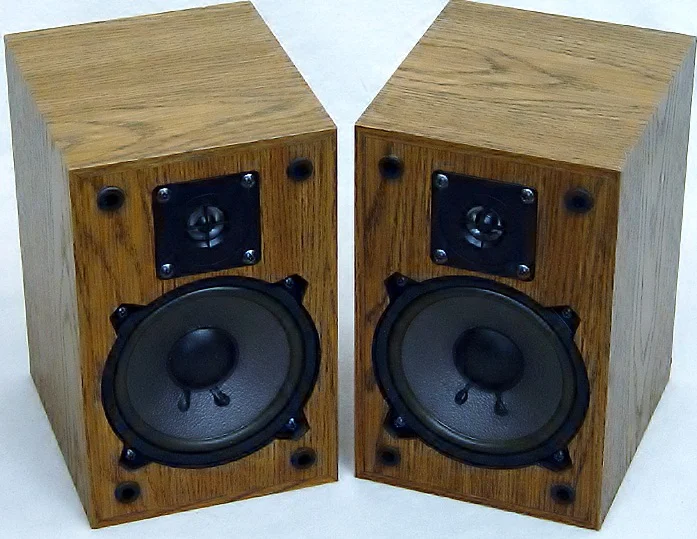
Record before you shortlist
- Usable cabinet width, depth and height at both positions
- Room for connections and manufacturer-required clearance
- Main listening distance and source connections
- Existing amplifier model and supported speaker loads
- Whether a separate subwoofer is planned
1.Measure the space the speaker can actually use
Measure the width, height and depth available at each speaker position. The tighter side sets the limit for the pair. Include the edge of the supporting surface, anything the cabinet might hit, and the space behind its terminals. A speaker that fits a product drawing may still protrude once the cable is connected.
Work through a shallow shelf
Suppose the shelf gives you 28 cm of usable depth. A candidate's cabinet is 24 cm deep, and your plug and cable need another 4 cm behind it. You have used all 28 cm before allowing any distance the manufacturer specifies behind the speaker. That candidate might work on a deeper stand. It is a poor shortlist choice for this shelf unless you can meet the clearances with a different placement or approved connector arrangement.
If a rear port faces the wall, read the speaker's own placement instructions. A front port can remove one clearance constraint, while the wall and shelf surface still affect the bass. A speaker marketed as a bookshelf model can work on stable furniture if it fits and sounds balanced there. Stands become useful when they solve a height, stability or clearance problem.
2.Decide which seat comes first
Measure from the expected speaker position to the main listener. A desk and a couch ask different things of the same pair. At a desk, check whether both speakers can aim toward your ears without one being blocked by a screen. Across a living room, check whether the pair can play comfortably at your regular seat without strain or sharpness. Keep levels comfortable while comparing.
If one side sits near a corner and the other opens into a hallway, expect the two sides to interact differently with the room. Compare two plausible layouts before taking a bass difference as proof that the speaker is wrong for you. For angles and spacing after purchase, follow the speaker placement guide.
For setup after purchase, read the Speaker Placement: Get Clearer Stereo Sound in Your Room.
3.Check the amplifier and inputs
With passive speakers, read the speaker's impedance specification alongside your amplifier's published requirements for the outputs you plan to use. If a combination is unclear, check the manuals or ask the manufacturer before buying. Sensitivity figures can help you compare likely output at similar input levels when the measurement conditions match. A wattage number by itself cannot establish compatibility or tell you how loud a pair will play at your seat. See speaker sensitivity and impedance for examples of different rating conditions.
With powered speakers, make sure the pair accepts the source you depend on. For TV use, check the connection and how you will control volume. For a desk, check available inputs, cable reach between the speakers and the position of the powered cabinet. A built-in amplifier still requires a usable source connection and access to power. Compare the two system types if you have yet to choose between them.
For rating conditions, read the Speaker Sensitivity and Impedance: Read the Numbers.
To choose a system type, read the Active vs Passive Speakers: What Does Your System Need?.
| Situation | First check | What would change the shortlist |
|---|---|---|
| Shared living room and a shallow console | Cabinet depth, plugs, wall clearance and usable left/right spacing | Choose a shallower enclosure or plan stands if the console makes placement impossible. |
| Existing stereo amplifier | Supported speaker load and connection requirements | Ask the manufacturer about any undocumented combination before ordering. |
| Nearfield desktop listening | Treble height, available inputs and usable volume control | Favor a pair you can raise or aim safely. |
| Movies or bass-heavy music without a subwoofer | At-seat bass and comfort at your usual level | Audition another pair if the same missing bass is audible from several seats. |
4.Make a bass decision before buying
If you plan to keep the system as a stereo pair, listen to familiar material that tells you whether the speakers reach the bass you actually care about. Listen at your expected seat and volume. If a note disappears mainly at one seat, try another position before spending more. For a future subwoofer, confirm how it connects and whether the system can filter bass from the main speakers or only send a separate sub signal.
5.Compare your finalists under the same conditions
Start with one centered voice, one recording with bass notes you recognize, and one busy section at your normal volume. When possible, compare the speakers in the same positions and match levels by ear or with a consistent measurement. Make a short note about dialogue or vocals, bass evenness and fatigue. Check whether the impression holds across all three excerpts before spending more.
Keep a short shopping card with five fields: maximum cabinet depth, intended seat distance, source inputs, amplifier compatibility and bass plan. A candidate earns an audition when it fits the room and the connections. The audition then tells you whether you want to live with the sound.
6.Key terms and common questions
(2)Common bookshelf speaker questions
Do bookshelf speakers need stands?
Use stable furniture if it provides suitable height, clearance and positioning. Stands are useful when they solve a specific placement or stability problem.
Does every small room need a subwoofer?
The decision depends on desired bass, listening level, the speaker and the room. Compare at your usual seat and check the connection and filtering options before planning an additional subwoofer.
7.Technical references and editorial scope
- Genelec: monitor placement ↗
- Klipsch: choosing speakers for a room ↗
- Yamaha R-N600A: speaker connections ↗
Research-based educational guidance. Sources support fact checking; they are not text to reproduce. No original measurements or hands-on product test are claimed. Follow the instructions for your equipment. Our editorial and corrections policy.
Have a question or spotted a correction? Write to the editors ↗